


Cardamomo, the world’s first 100% inclusive flamenco tablao
4/17/2026
The Cardamomo tablao in Madrid becomes the world’s first 100% inclusive venue with the “Flamenco sin barreras” project
The iconic Madrid flamenco tablao Cardamomo has become the first in the world to offer a fully inclusive experience thanks to "Flamenco sin barreras", an innovative sensory accessibility project aimed at people with visual and hearing impairments.
The initiative was presented yesterday, 16 April 2026, at an event hosted by actress and journalist Patricia Bonet, who explained the full scope of the project. Artists Antonio Canales, La Flaka, Claudia de Utrera and Karime Amaya attended, along with Juan Melgar, Director of the Cultural Industries Coordination Centre at the Ministry of Culture.
A pioneering sensory accessibility project
"Flamenco sin barreras" has been made possible thanks to the management and technical advice of ONCE, and the collaboration of ILUNION Accesibilidad, a company specialising in designing accessible environments, services and products with a 360º vision. Together with the tablao’s team, these organisations have implemented state-of-the-art technology to remove sensory barriers and allow everyone to feel the emotion of flamenco on equal terms.
Cardamomo’s owner, Ivana Portolés de Val, highlighted the social dimension of the initiative: “This project has been an extraordinary journey with an ending that makes us very happy: bringing flamenco to the whole of society. We can’t think of a better legacy. We have turned the tablao into a complete sensory space and flamenco into an accessible, universal art form.”
For his part, the tablao’s managing director, José Díaz, pointed out that the project has been supported by ERDF funds through the Recovery, Transformation and Resilience Plan. “We are bringing together art and technology so that flamenco can be experienced through all the senses and appreciated by everyone,” he said.
Cultural and lifestyle expert Ana González Arenas, an ONCE collaborator and driving force behind the project, underlined the emotional origin of the initiative:
“Flamenco is felt with the soul, not with the eyes. The idea was born from an unforgettable night at Cardamomo, realising that the magic of the guitar, cajón and footwork is perceived in the brain and in the heart. It was only right to create a space where that ‘duende’ would be accessible to everyone.”
An Accessibility Ecosystem to experience flamenco
During the presentation, the Accessibility Ecosystem was unveiled, a set of resources where technology is placed at the service of art. It includes:
- Sensorial Route: five tactile points so that people with visual impairments can explore the space and flamenco costumes. Models of a dress, shawl, flamenco shoes, guitar and castanets allow these elements to be understood in a haptic way.
- Hearing accessibility, via two key tools:
- Latest-generation induction loop, providing clear, direct sound to users of hearing aids or cochlear implants.
- Subpac vests, haptic devices that transmit the vibrations of the rhythm, footwork and frequencies of the show, allowing deaf people to feel flamenco in their own bodies.
The emotion of flamenco, put to the test
The presentation concluded with performances by dancers Paula Rodríguez and José Escarpín, a practical demonstration of the new accessibility measures. The event ended with a unique Sevillana performed by José Galán and his student Lola García-Baquero, putting the finishing touch to a historic day for inclusion in flamenco art.
Source: Mareaglobal.com
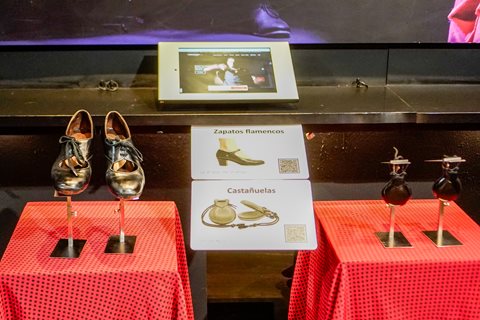
Shoes and castanets - Mareaglobal.com
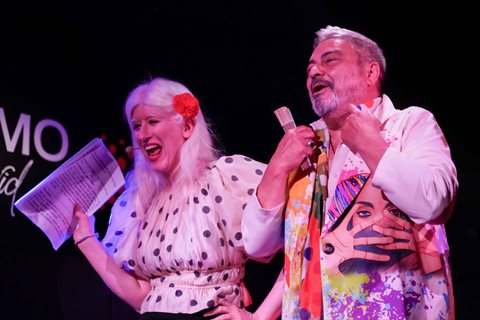
Patty Bonet and Antonio Canales at the presentation - Mareaglobal.com
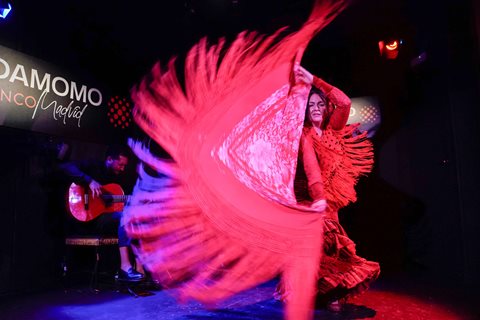
Performance by Paula Rodríguez at the presentation - Mareaglobal.com
